

Parent Hub · Knowing when to worry
Is my newborn's head shape normal? Cone heads, flat spots and the 6-week check
Most newborn heads look a little pointed or uneven after birth, and that birth shape usually settles within about 6 weeks. A newborn flat head is different: it forms after birth where the head rests, and it usually gets more obvious until about 4 months. Flattening you can still see at the 6-week check is worth acting on now.


The short version
Key takeaways
-
1
A pointed or uneven head after birth is common and usually settles within about 6 weeks.
What a normal newborn head looks like -
2
A positional flat spot forms after birth where the head rests, at the back or on one side.
Flat spot or birth shape? -
3
Flat spots usually get more obvious until about 4 months, so the 6-week check is the time to raise one.
What happens at the 6-week check? -
4
A favourite side often means a tight neck. Physio started before 3 months is linked to a better outcome.
Why a tight neck matters -
5
If a flat spot is showing, act in the next few weeks: head growth is fastest now, and most babies start rolling between 4 and 6 months.
What to do if you can see one
If you keep catching yourself staring at the back of your baby's head after a feed, you're not overreacting. Most odd-looking newborn heads are birth shape that settles, but a newborn flat head that turns up after birth is a different thing, and the 6-week check is your first good chance to tell the two apart. We've been there: by 2 months, our daughter was favouring one side, her neck was tight and a flat spot was forming.
What does a normal newborn head shape look like?
A normal newborn head is often not round. Plenty of babies arrive with a head that looks long, pointed or a little lopsided, and a head shaped more like a cone than a ball is common straight after birth.1 It can look alarming in the first photos. It isn't a flat spot.
That birth shape settles quickly. Pregnancy, Birth and Baby, the Australian Government-funded health service, says a baby's head returns to a more usual shape within 6 weeks of birth.2 So by the 6-week check, most of what you saw in hospital should have rounded out.

How is a newborn flat head different from birth shape?
A positional flat spot usually isn't there at birth. It forms in the weeks after, on the part of the head your baby rests on, in one of two ways:
- Flat on one side of the back (plagiocephaly). From above, the head looks slanted, and the ear on that side can sit further forward.
- Flat across the back (brachycephaly). From above, the head looks wide and short.
The clearest view is from directly above. Take a photo looking straight down at the crown, then repeat it every two weeks in the same spot and light, so you can see any change. Our guide to the four signs of a flat head shows exactly what to look for.

| Birth shape | Positional flat spot | |
|---|---|---|
| When it shows | From birth | In the weeks after birth, often by 6 to 12 weeks |
| Where | The whole head can look long, pointed or uneven | The part your baby rests on: one side of the back, or right across it |
| A favourite side? | Not part of it | Often |
| What happens next | Usually settles within about 6 weeks | Usually most obvious around 4 months |
| What helps | Time | Photos from above, a physio for the neck, and taking the pressure off the flat spot |
One thing to watch: birth shape should be settling by about 6 weeks. If your baby's head looked unusual from birth and hasn't improved, see your GP rather than waiting.
Why do flat spots form after birth?
Flat spots form because your baby's head is growing fast while it rests in the same place. On the World Health Organization growth standards, a baby's head grows about 6 cm around in the first 3 months, more than it grows in the 9 months after that.3 That growth pushes outwards everywhere except where the head is resting. Rest on the same spot for most of the day and night, and growth there is held back and goes elsewhere instead.4 That's a flat spot.
Back sleeping is right for every baby, and it's also why flat spots are so common. In a Canadian study of 440 babies checked at 7 to 12 weeks, nearly half had some flattening, and most of it was mild.5 This isn't something you caused.
Back sleeping is right for every baby, and it's also why flat spots are so common.
A tight neck makes a flat spot far more likely. If your baby can't turn their head evenly, they rest on the same spot every time, and turning their head only lasts until they turn it back. A tight neck muscle (torticollis) has been reported in as many as 70 to 95% of babies with positional flattening.6 Our guide to why babies always turn their head to one side covers the signs.
What happens at the 6-week check?
At the 6-week check, your GP looks over your baby from head to toe: weight, length and head circumference on a growth chart, plus hips, heart, eyes and how your baby moves. Head shape is on that list too.7

It's a short appointment with a lot to cover, so if the head is on your mind, bring it up yourself. Take your photos from above and ask:
- Is the back or one side of the head flatter than you'd expect?
- Does my baby turn their head equally both ways?
- Does their neck feel tight on one side?
- Can we have a referral to a paediatric physiotherapist?
If you're told flat spots are common and to wait and see, that's often fair for a mild one. What nobody can tell you at 6 weeks is whether yours will stay mild, and by the time you'd know, the fastest months of head growth are behind you.
What nobody can tell you at 6 weeks is whether yours will stay mild, and by the time you'd know, the fastest months of head growth are behind you.
If your baby favours one side, get a paediatric physio onto the neck now rather than later. The Royal Children's Hospital Melbourne notes that physiotherapy started before 3 months is associated with a better outcome for a tight neck.8
What should I do if I can see a flat spot at 6 weeks?
Start now. Flat spots usually peak around 4 months: in a New Zealand study that measured 200 babies from birth, flattening was most common at 4 months.9 Most babies start rolling between 4 and 6 months. At 6 weeks, you have the most time on your side.
-
1
Photograph the head from directly above
Today, then every two weeks.
-
2
Book a paediatric physio for the neck
Especially if your baby has a favourite side.
-
3
Keep up tummy time and mix up positions while your baby is awake
Our guide to what you can do at home has the detail.
What you can do at home -
4
Take the pressure off the flat spot
Where your baby spends the most hours: in the cot.
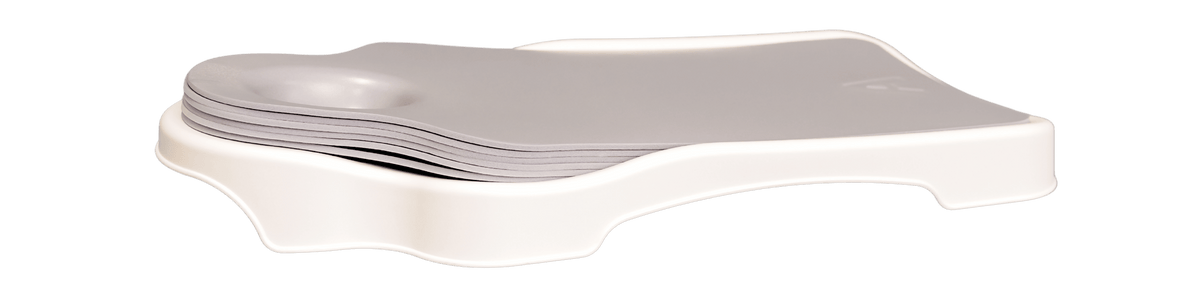
The fourth step is the one families find hardest, because nobody can hold a head in place overnight. That's what the Perfect Noggin is for.

The Perfect Noggin is a contoured head shaping surface designed by paediatric craniofacial surgeon Dr Gary Rogers. Its recessed cup for the back of the head takes the weight off the flat spot, so your baby's head naturally grows back into that space. It works whichever way your baby turns, with no repositioning, so it doesn't fight a favourite side. Your physio looks after the neck. The Perfect Noggin takes the pressure off the flat spot.
Safety comes first in the design. It's firm and near flat, with no loose parts and nothing strapped in, so your baby is free to move their head. Once your baby starts rolling from back to tummy, use it supervised only (watching on a video monitor counts), and stop once they're rolling regularly.
Most parents see a visible difference within 6 to 8 weeks of consistent use. Results vary. Count back from rolling and the maths is simple: every week of waiting is a week less of use. For babies 1 to 3 months, the 12-week hire ($360, about $30 a week) covers the weeks that count most, with free delivery and return in Australia. Or buy new for $450 and it's yours to keep.

Suitability check
Check if Perfect Noggin is right for your baby
5 quick questions, about 30 seconds. We’ll tell you if it suits your baby and how to give them the best start.
We ask about
- Your baby’s age
- Rolling
- A quick safety check
- Head shape
- Turning to one side
General information, not a clinical assessment.
 Next read
How do I know if my baby has a flat head?The four-point check you can do at home in two minutes, and what to photograph before an appointment.
Frequently asked questions
How long does it take a newborn's head to round out after birth?
Most newborn heads return to a more usual shape within about 6 weeks of birth. If your baby's head looked unusual from birth and hasn't improved by then, see your GP.
Is it normal for a newborn to have a flat spot?
It's common: nearly half of babies have some flattening at 7 to 12 weeks, most of it mild. Because flat spots usually get more obvious until about 4 months, act early, especially if your baby has a favourite side.
Will a flat spot at 6 weeks go away on its own?
Some mild flat spots look better as babies grow. Nobody can tell you at 6 weeks whether yours will, and by the time you'd know, the months the Perfect Noggin can be used are mostly gone. Our guide to whether a flat head goes away on its own sets out what the research shows.
Should I use a newborn head shape pillow?
No. Pregnancy, Birth and Baby advises avoiding pillows, cot bumpers and sleep devices used to hold a position. The Perfect Noggin is a different design: a whole, firm, near flat head shaping surface with no loose parts and nothing holding your baby in place. Our guide to head shaping pillows sets out the difference.
Can my newborn use the Perfect Noggin?
Yes, once a flat spot or a favourite side is showing. It fits head circumferences from 33 to 48 cm, which covers 99% of babies under 6 months, and four foam layers swap out as the head grows. Your baby uses it until they're rolling regularly. It isn't suitable for babies with craniosynostosis, severe reflux, breathing or heart problems, or bone or joint abnormalities, so speak to your paediatrician first if any of those apply.
Sources and references
The numbers in the text link to these sources, so you can check them for yourself.
-
1
American Academy of Pediatrics. Your baby's head. HealthyChildren.org. View source (opens in a new tab)
-
2
Pregnancy, Birth and Baby. Flat head in babies. Last reviewed November 2024. View source (opens in a new tab)
-
3
World Health Organization. Child Growth Standards: head circumference-for-age, birth to 5 years (boys and girls). View source (opens in a new tab)
-
4
Rogers GF. Deformational plagiocephaly, brachycephaly, and scaphocephaly. Part I: terminology, diagnosis, and etiopathogenesis. Journal of Craniofacial Surgery, 2011. View source (opens in a new tab)
-
5
Mawji A, et al. The incidence of positional plagiocephaly: a cohort study. Pediatrics, 2013. View source (opens in a new tab)
-
6
Fenton R, Gaetani SA. A pediatric epidemic: deformational plagiocephaly/brachycephaly and congenital muscular torticollis. Contemporary Pediatrics, 2019. View source (opens in a new tab)
-
7
Fasher M. The 6 week check: an opportunity for continuity of care. Australian Family Physician, 2012. View source (opens in a new tab)
-
8
The Royal Children's Hospital Melbourne. Congenital muscular torticollis, orthopaedic fact sheet. View source (opens in a new tab)
-
9
Hutchison BL, Hutchison LA, Thompson JM, Mitchell EA. Plagiocephaly and brachycephaly in the first two years of life: a prospective cohort study. Pediatrics, 2004. View source (opens in a new tab)
About this guide
How this guide was written
Based on published research
Each guide draws on peer-reviewed studies, including Dr Rogers’ own published work on flat head.
Sources on every guide
Every guide lists its references at the end, so you can read them for yourself.
Clearly dated
The date at the top shows when this guide was last updated.
Information, not a diagnosis
A guide can’t assess your baby. Your GP, child health nurse or a paediatric physiotherapist can.
Written by

Joel and Vanessa Hope
Perfect Noggin Australia
We’re Brisbane parents who went through a flat spot with our own daughter. We wrote this guide from published research, and every source is listed above.
The research it draws on

Dr Gary Rogers
Paediatric craniofacial surgeon
Dr Rogers didn’t write this guide. It draws on his published research on flat head. He also designed the Perfect Noggin, so we say so here. Meet Dr Gary
Spotted something out of date? Email support@theperfectnoggin.com.au
The Perfect Noggin
Ready to take the pressure off?
Designed by paediatric craniofacial surgeon Dr Gary Rogers. It takes the pressure off the flat spot so growth can go back into it, alongside your physio’s work on the neck.
- Nothing straps or holds your baby
- Four foam layers that grow with them
- From birth until your baby starts rolling
Hire
From $30 a week
6 or 12 weeks. Free delivery and return in Australia.
Buy new
Yours to keep
Keep it for a future baby. Free standard delivery in Australia and NZ.
The window
The earlier you start, the more head growth is still to come.
Keep reading
More from the Parent Hub
 Checking your baby's head shape
How do I know if my baby has a flat head?The four-point check for plagiocephaly you can do at home in two minutes, and when to see a physio instead of waiting.
 The neck behind the flat spot
Why does my baby always turn their head to one side?The earliest sign is a head turning preference, not a tilt. What to look for and when to ask for a physiotherapy referral.
 How flat head develops
Does a baby's flat head go away on its own?What happens to your baby's head shape from birth to twelve months, and what is still possible at your baby's age.
You’re in step 1 of 4
- 1Is it a flat spot?
- 2Why it happens
- 3What you can do now
- 4Your options