

Parent Hub · Long term
Do flat heads last into adulthood? What adult head scans and 2,800-year-old skulls show
Sometimes, yes. In a 2026 study of head scans from 242 young adults in Japan, nearly 1 in 5 had moderate to severe flattening on one side. A German study the same year found fewer, about 1 in 9 with more asymmetry than the cut-off used for babies. And the same flat spot shows up in adult skulls from 2,800 years ago. A flat area doesn't fill back in by itself, which is why the first months matter most.


The short version
Key takeaways
-
1
In a 2026 Japanese study of 242 young adults, more than half met the criteria for a flat spot on one side, and nearly 1 in 5 had moderate to severe flattening.
Adults in Japan -
2
A 2026 German study of 146 teenagers and adults found fewer: about 1 in 9 had more asymmetry than the cut-off used for babies. How many you find depends on who is measured, and how.
Adults in Germany -
3
Skulls from about 800 BC in Italy show the same flat spot, in adults, with the same pattern doctors see in babies today.
2,800-year-old skulls -
4
A flat spot that lasts is about how the head looks. A positional flat head doesn't affect brain development.
Does it matter? -
5
A flat area doesn't fill back in by itself. The first months, when the head grows fastest, are when you can change the most.
What to do now
Most parents are told their baby will grow out of a flat spot. For many babies it does become less noticeable as the head grows. But researchers have now looked at what's left in adulthood, and the answer isn't zero. Here's what three recent studies found, and what it means for what you do now.
How many adults still have a flat spot?
It depends on the study, but it isn't rare. In 2026, doctors in Japan measured head scans from 242 people aged 15 to 39 who'd had a CT scan in an emergency department, with nothing wrong inside the head.1 More than half (53%) met the criteria for plagiocephaly, a flat spot on one side, and nearly 1 in 5 (19%) had moderate to severe flattening. People born before and after Japan's back-to-sleep campaign had similar head shapes, and men's heads measured more uneven than women's.1
A German study published the same year found far fewer. Researchers used 3D photos to measure the heads of 146 teenagers and adults, average age 26, most of them patients at a hospital jaw clinic. About 1 in 9 (11.5%) had more asymmetry than the cut-off used for babies on one common measure, and 7% on another.2 The authors took this to mean flat spots are less common in adulthood than in infancy.
| Japan | Germany | |
|---|---|---|
| Who was measured | 242 people aged 15 to 39 who had a head CT in an emergency department | 146 teenagers and adults, average age 26, mostly from a jaw clinic |
| How | CT scans | 3D photos |
| Flat on one side | 53% met the criteria; 19% moderate to severe | 11.5% by one measure, 7% by another |
Neither group is a random sample of adults, and neither study has baby records.
Why the gap? Different countries, different groups of people, different ways of measuring and different cut-offs. Neither study has baby records, so nobody knows how these heads looked at 4 months. What both show is that uneven head shapes are still measurable in some groups of adults.
What do 2,800-year-old skulls tell us?
That flat heads aren't new, and that they can last into adulthood. In 2026, researchers in Italy examined 26 adult skulls from Matelica, in central Italy, dating from about 800 BC.3 11 of the 26 (42%) were flat at the back on one side. Most were on the right (73%) and most were male (64%). 7 people had signs in their skeletons possibly consistent with a tight neck (congenital muscular torticollis).3
That's the same pattern doctors see in babies today: more often on the right, more often in boys, and often with a tight neck.4 The researchers think it came from babies spending long stretches with their head in one position, possibly because of how they were cared for.3 These were adults, so the flattening was still visible long after infancy.
Why doesn't a flat spot fill back in on its own?
Because a flat area changes most while the head is growing fastest, and that's in the first months.5 Once your baby can move their head freely, usually by about 4 months, the flattening stops getting worse, but nothing pushes the flat area back out. The head grows around it.6 Does a baby's flat head go away on its own? goes through it month by month.
A flat spot that lasts is about how the head looks. A positional flat head doesn't affect brain development.7 Does a flat head affect my baby's development? covers the research in full.
What does this mean for your baby now?
Act early rather than wait and see. None of this means you did anything wrong, and back sleeping is still the right advice for every baby.8
-
1
Take a photo from above today
Then every 2 weeks, in the same light, so you can see change.
How to check for a flat head -
2
See a paediatric physiotherapist
We recommend a physio check of your baby's neck and head shape, especially if they always turn one way.
Why babies turn to one side -
3
Take the pressure off the flat area
Whenever your baby is lying on their back, starting as early as you can.
How long it takes, week by week

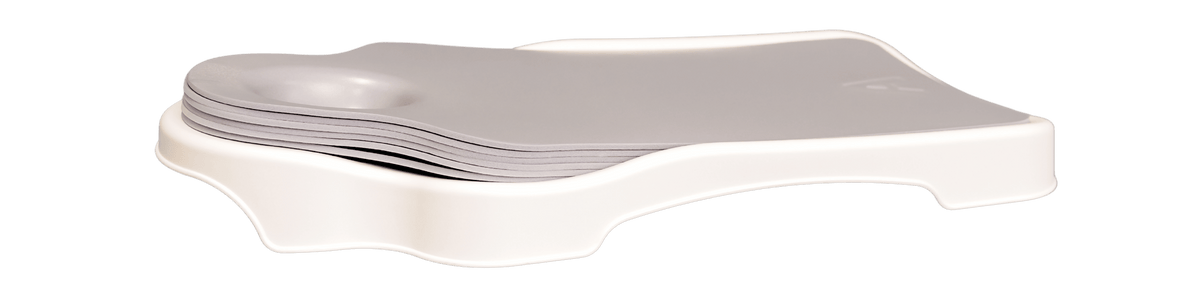
The Perfect Noggin is a contoured head shaping surface designed by paediatric craniofacial surgeon Dr Gary Rogers. Its recessed cup takes the pressure off the flat area, so growth can go back into it while the head is growing fastest. Your physio works on the neck. Once your baby starts rolling from back to tummy, use it supervised only (watching on a video monitor counts), and stop once they're rolling regularly.

Suitability check
Check if Perfect Noggin is right for your baby
5 quick questions, about 30 seconds. We’ll tell you if it suits your baby and how to give them the best start.
We ask about
- Your baby’s age
- Rolling
- A quick safety check
- Head shape
- Turning to one side
General information, not a clinical assessment.
 Next read
How long does a flat head take to improve?A week-by-week timeline: when parents usually see a difference, how long a tight neck takes, and how to measure the change.
Frequently asked questions
Can adults have a flat head from when they were a baby?
It looks that way. Researchers who scanned 242 young adults in Japan in 2026 found more than half met the criteria for a flat spot on one side, and nearly 1 in 5 had moderate to severe flattening. The study had no baby records, but the authors put it down to pressure on the head in infancy. Skulls from 2,800 years ago show the same pattern.
How common is a flat head in adults?
Studies disagree. A 2026 Japanese study found more than half of young adults met the criteria, while a 2026 German study found about 1 in 9. The groups, the measuring and the cut-offs were all different.
Why do studies of adults find such different numbers?
They measure different people in different ways: emergency CT scans in one, 3D photos at a jaw clinic in the other, with different cut-offs. Neither is a random sample of adults, and neither has baby records.
What did the 2,800-year-old skulls show?
11 of 26 adult skulls from about 800 BC in Matelica, Italy, were flat at the back on one side, mostly on the right and mostly in men, the same pattern doctors see in babies today.
Will my baby's flat head last into adulthood?
Nobody can say for any one baby. Many flat spots become less noticeable as the head grows, but the flat area doesn't fill back in by itself. The earlier the pressure comes off it, the more of your baby's growth can go back into it.
Sources and references
The numbers in the text link to these sources, so you can check them for yourself.
-
1
Inomata S, Kawahara Y, Tsuritani S, et al. Computed tomography-based evaluation of positional cranial deformities in emergency department patients aged 15 to 39 years in Japan. Journal of Craniofacial Surgery, 2026. View source (opens in a new tab)
-
2
Wilbrand JF, Heep E, Howaldt HP, Wilbrand M. Association between cranial morphology and dysgnathias in adolescents and adults: a prospective case-control study. Journal of Cranio-Maxillofacial Surgery, 2026. View source (opens in a new tab)
-
3
Beck De Lotto MA, Zanatta A, Zink A, Pacciani E, Paladin A. Before "Back to Sleep": deformational plagiocephaly and pediatric insights from Iron Age Italy. International Journal of Paleopathology, 2026. View source (opens in a new tab)
-
4
Rogers GF, Oh AK, Mulliken JB. The role of congenital muscular torticollis in the development of deformational plagiocephaly. Plastic and Reconstructive Surgery, 2009. View source (opens in a new tab)
-
5
World Health Organization. Child Growth Standards: head circumference-for-age, birth to 5 years (boys and girls). View source (opens in a new tab)
-
6
Rogers GF. Deformational plagiocephaly, brachycephaly, and scaphocephaly. Part I: terminology, diagnosis, and etiopathogenesis. Journal of Craniofacial Surgery, 2011. View source (opens in a new tab)
-
7
The Royal Children's Hospital Melbourne. Plagiocephaly and brachycephaly: misshapen head. Kids Health Info, reviewed September 2024, updated July 2025. View source (opens in a new tab)
-
8
Red Nose Australia. Safe sleeping. View source (opens in a new tab)
About this guide
How this guide was written
Based on published research
Each guide draws on peer-reviewed studies, including Dr Rogers’ own published work on flat head.
Sources on every guide
Every guide lists its references at the end, so you can read them for yourself.
Clearly dated
The date at the top shows when this guide was last updated.
Information, not a diagnosis
A guide can’t assess your baby. Your GP, child health nurse or a paediatric physiotherapist can.
Written by

Joel and Vanessa Hope
Perfect Noggin Australia
We’re Brisbane parents who went through a flat spot with our own daughter. We wrote this guide from published research, and every source is listed above.
The research it draws on

Dr Gary Rogers
Paediatric craniofacial surgeon
Dr Rogers didn’t write this guide. It draws on his published research on flat head. He also designed the Perfect Noggin, so we say so here. Meet Dr Gary
Spotted something out of date? Email support@theperfectnoggin.com.au
The Perfect Noggin
Ready to take the pressure off?
Designed by paediatric craniofacial surgeon Dr Gary Rogers. It takes the pressure off the flat spot so growth can go back into it, alongside your physio’s work on the neck.
- Nothing straps or holds your baby
- Four foam layers that grow with them
- From birth until your baby starts rolling
Hire
From $30 a week
6 or 12 weeks. Free delivery and return in Australia.
Buy new
Yours to keep
Keep it for a future baby. Free standard delivery in Australia and NZ.
The window
The earlier you start, the more head growth is still to come.
Keep reading
More from the Parent Hub
 How flat head develops
Does a baby's flat head go away on its own?What happens to your baby's head shape from birth to twelve months, and what is still possible at your baby's age.
 Development and long-term outcomes
Does a flat head affect my baby's development?In this article, we answer whether a flat head affects your baby's development, covering what the clinical research actually shows about brain development.
 Timing and the improvement window
Can a flat head still improve after four months?Why acting earlier in the first six months works better, and what is realistic at your baby's age.
You’re in step 2 of 4
- 1Is it a flat spot?
- 2Why it happens
- 3What you can do now
- 4Your options