


25+
Years of expertise behind the design
15+
Years developing the Perfect Noggin
5
Peer reviewed clinical studies
The flat head problem
Since the ‘Back to Sleep’ campaigns in the 1990s, flat heads have become five times more common in babies today.
Back sleeping is still the right advice.
Thankfully, there's a way to safely take the pressure off the flat spot, while they stay on their back.
1 Biggs 2003.
Does your baby's head look like this?
Viewed from above. Tap the closest shape.


Flat on one side
Positional plagiocephalyOne side of the back is flatter, so from above the head looks slanted. One ear may sit slightly forward, and there is often a favourite side.
What most parents aren't told
-
Tummy time and holding your baby only covers the hours they're awake. The flat spot forms while they lie on their back.
-
Turning their head rarely works. A tight neck (torticollis) pulls them straight back to their favourite side. That part is one for your physio.
-
Flattening usually peaks around 4 months. The earlier you start, the more growth there is to influence head shape.
-
Not every flat spot rounds out on its own. The more severe it is, the more likely it is to stay without the right support.
Getting started
3 simple steps to a rounder head
Measure, fit and lay them down
- Measure their head with the tape supplied and choose the matching foam layer
- Lay bub on their back, with the back of their head in the recess
- Send us a fit photo and we'll confirm the fit within 24 hours
What this step does
Four foam layers fit head sizes from 33 to 48cm, which covers 99% of babies under 6 months. Nothing straps or holds your baby in place, and their head still turns freely both ways.
Build up to every time they're on their back
- Start with floor play, then build up to every time they're on their back (up to 16 hours a day)
- Most babies settle in within 1 to 2 weeks
- Your usual swaddle or sleep sack is fine
What this step does
The recess is shaped like the back of a naturally rounded baby's head. It takes pressure off the flat spot, so their head's natural growth can go back into it.

Measure weekly and watch for change
- Re-measure each week, and move up a layer when the fit is too tight.
- Take a photo from above each week so you can compare
What this step does
As their head grows, it naturally expands into the contoured space. Most parents see a visible, rounded difference within 6 to 8 weeks of consistent use.
See some of the results of 20K relieved parents
See the stories from parents who were concerned about their baby's head shape.
-

“My health visitor came round today, she seemed to think it was because I did more tummy time until I told her the Perfect Noggin fixed it!! So grateful for this product, we got our sleep back and I rarely think about his head shape compared to how it was before.”
-

“Started our Perfect Noggin journey at 4 months old, now just turned 6 months old and this is the result! We just used it to sleep in overnight and are so pleased with the outcome. To anyone questioning whether to buy the Perfect Noggin, it is definitely worth the investment!”
-

“I wanted to share our before and after pics. The picture on the left is at 2 months, before using the Perfect Noggin. The picture on the right is today, a few weeks after we stopped using the Perfect Noggin at 5 months. No helmet for us! Thanks so much!”


You see your baby's flat head. You've done tummy time and repositioning, but it isn't rounding out like you thought it would. You're not imagining it, and you're not out of options.

Designed with safety as the top priority
You've been told to keep the cot clear, and you're right to be careful about anything that goes in it. So here's exactly what Perfect Noggin is and what it isn't.
It's not a pillow. Your baby's whole body lies on it.
A pillow raises the head and has soft edges. Perfect Noggin is one firm surface your baby lies on, with a 3 degree incline, which is close to flat. The back of the head rests in a shallow recessed cup. Nothing loose, nothing to sink into.
They are on their back, free to turn their head
Your baby lies on their back, as recommended, with nothing else in the cot. Nothing holds, straps or limits them. They can turn their head either way, and the contour still keeps weight off the flat area.
Their is chin up, not tucked. The opposite of a pillow
The recessed head cup positions your baby's head and torso in a straight, neutral line, keeping their airway fully open. A pillow does the opposite: it tilts the chin down, flexes the neck, and narrows the airway.
It comes out of the cot once they start rolling
As soon as your baby shows signs of rolling, stop using it. We'd rather you stop a week early than a day late. That's why it's made only for babies under 6 months.
Hear it from parents who were exactly where you are

The Clinically Proven Option You Can Trust
Designed and clinically tested to help promote a round head during the critical first months of life
Developed, tested and refined in hospitals
Five published, peer-reviewed studies test both effectiveness and safety.
Designed by a specialised skull surgeon
A Harvard-trained paediatric craniofacial surgeon designed every detail, based on how infant skulls grow.
Fifteen years of supporting real babies
Refined in hospitals through 15+ years of clinical use. Thousands of babies came before yours and shaped the design.
Works alongside physiotherapy
Designed to work alongside your physio's treatment plan, not replace it.
Proven Support When you Need it Most


The Perfect Noggin was refined in hospitals long before it reached your home nursery.
Dr Gary Rogers designed the Perfect Noggin inside a teaching hospital. It started life as the Cranial Cup, went through real hospital trials, and was later refined into the Preemie Orthotic Device, known as the Plagio-Cradle. What you get today is the third generation of that same design, adapted from a hospital setting into something practical for home use. The look has changed over fifteen years. The contoured head cup at the centre of those original hospital trials hasn't. It's still a firm surface your baby's head grows into while they lie on their back.
See Clinical StudiesTested in Five Clinical Trials, Before It Was Ever Called the Perfect Noggin
6.0mm
Younger babies have more head growth ahead of them, and more capacity for their shape to change. Babies who started using the Perfect Noggin before 10 weeks old saw plagiocephaly improve by an average of 6.0mm over 6 weeks. Those who started between 10 and 20 weeks improved by an average of 4.0mm. Later isn't too late. Sooner is best.
7.7x
A prospective clinical trial found that repositioning and stretching on their own improved head asymmetry by an average of 1mm. With the Perfect Noggin, the improvement was 7.7 times greater. If you've been told to just keep turning your baby's head and it's not working, you're not getting it wrong. The advice you were given just isn't enough.
46%→19%
In one randomised controlled trial, 46% of hospitalised babies who were repositioned alone still had abnormal head measurements at discharge. Among babies who used the Perfect Noggin, that number was 19%. Repositioning alone left far more babies with head shape issues unresolved.
83%
"In a study of 23 premature babies in the NICU, 86% had abnormal head measurements at the start. By discharge, after using the Perfect Noggin, 83% had head shapes in the normal range. Even for the smallest, most vulnerable babies, it made a real difference.

Join 20,000+ relieved parents
-

“You are doing an amazing job with this product and the advice you give out in your own (very valuable) spare time. My boy was in the Perfect Noggin for 2 months and it has done absolute wonders for his shape! I’m so so happy with the results and have been spreading the word in Australia about how amazing this device is.”
-

“If you are on the fence because your baby is a little older - BUY IT. We didn’t find the Perfect Noggin until our kiddo was 4 months, but we figured it was cheaper than a helmet so we would try it anyway. We are SO THRILLED with his head shape after one month of use. Thank you SO much for making this product!”
-

“My son just turned 7 months. He was rolling before this but never for sleeptime so I had some extra time to extend the use of the Perfect Noggin. THE PERFECT NOGGIN DOES WORK. 2 months of ALL sleep in this device and I think his head looks much much better! IF you are on the fence about the Perfect Noggin BUY IT!”


Stop the Exhausting Repositioning Routine
The Perfect Noggin makes support simple. The recessed cup works while your baby lies on their back, so you don't have to.
No more waking up to turn their head
No repositioning. The recessed cup gently supports even, symmetrical growth while they lie on their back.
Made for babies who only turn one way
A strong side preference or torticollis doesn't stop it working. The contour keeps the pressure off the flat spot even when your baby favours one side.
It grows with your baby when they need it most
Removable layers adapt as your baby's head grows. It fits 99% of babies under six months, with nothing to replace and no clinic visits to adjust the fit.
Comfortable for your baby
Parents report longer stretches and faster settling. In one mum's words: "He instantly started sleeping longer stretches and actually seemed more comfortable."
Helmet, or wait and hope. There's a third option, and most parents never hear about it.
Designed by a craniofacial surgeon, trialled in hospitals for over a decade. Now it's available for your baby at home.

- Suitable from birth. The sooner you start, the more room there is for change, and the sooner you'll see it.
- Works even with torticollis and a strong side preference. No more turning your baby's head again and again.
- No appointments, no fittings, nothing to explain to anyone. Just gentle support at home while your baby lies on their back.
- Nothing loose or soft in the cot, unlike a head-shaping pillow.
- Four foam layers you move up as your baby grows, so there's no need to buy more than one size.
- A contoured recess your baby's head grows into, shaped to support a rounder head.
How The Perfect Noggin Works
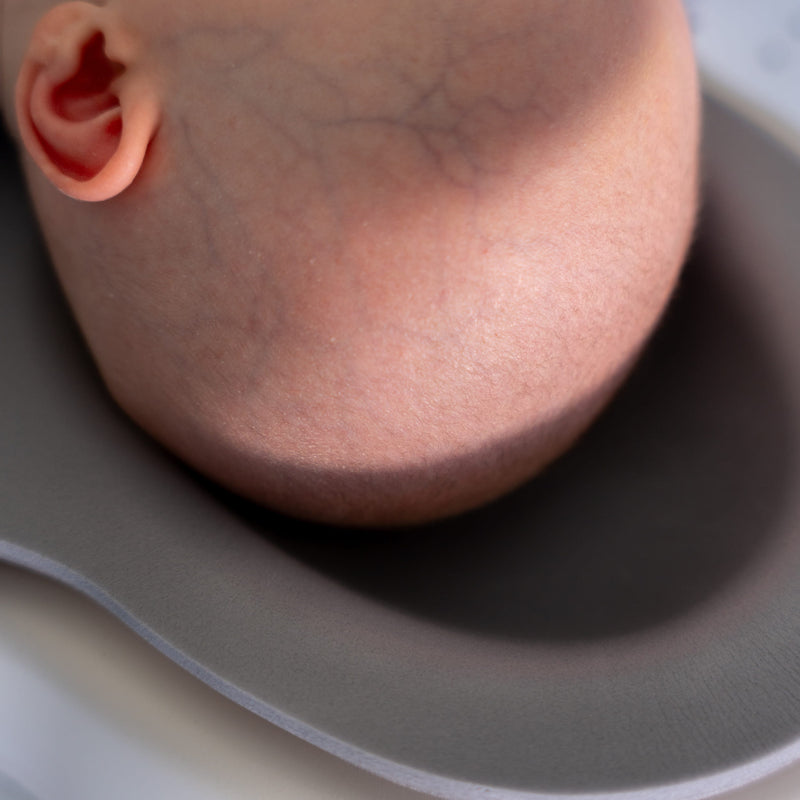
The recessed cup is shaped like an ideal head shape.
The recessed head cup gently cradles the head, redistributing pressure away from flat spots and providing a symmetrical mould for growth. However your baby turns their head, there are no flat surfaces against which the head can flatten.
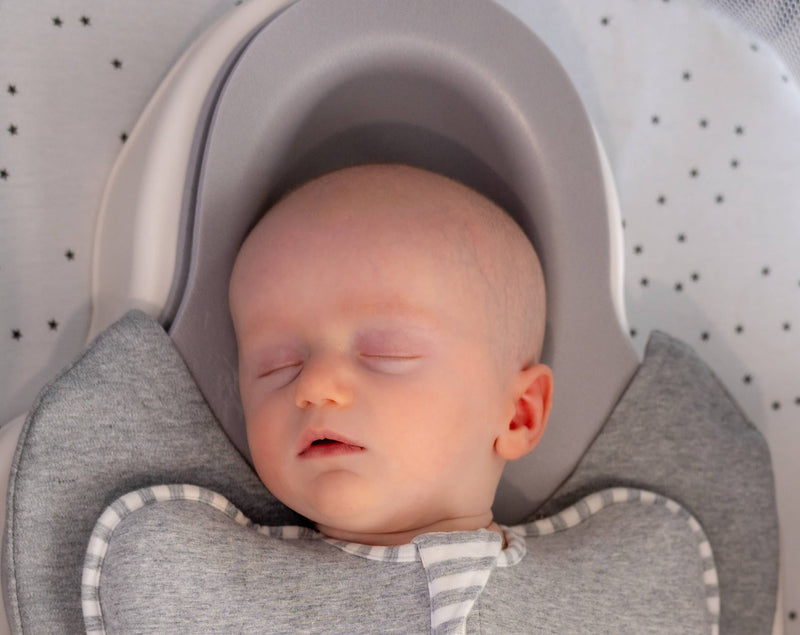
Pressure comes off the flat spot
Gentle pressure sits on the rounder or higher areas of the head, opening up space for the flatter areas to grow into. Growth happens where there's least pressure, which is what evens out the asymmetry.

Supports natural head shape development
As your baby grows, you remove foam layers, so there's always room for the flatter areas to keep rounding out. No wedging, nothing restricting movement, and no loose or soft parts that would carry a suffocation risk.
Founders Story
Approximately 40% of infants who are placed on their back will develop undesirable changes in cranial shape despite diligent parental efforts at head repositioning and tummy time.
In fact, acquired head shape concerns are among the most common problem I encounter in my clinical practice as an academic craniofacial surgeon.
The Perfect Noggin embodies all of the fundamental principles I have learned over two decades of scientific inquiry in this field and is, in my opinion, unparalleled in its design and application.
It's patented, adjustable, anatomically-correct surface promotes natural and symmetrical cranial growth without the need for constant repositioning, expensive helmets, unsafe pillows, or months of sleepless nights.
With 5 peer-reviewed clinical studies and over a decade of success, the Perfect Noggin is the best head shaping surface you can buy for your infant at any price.
Dr Gary Rogers
Learn More About Dr Rogers
Contact Us
Both our kids developed plagiocephaly at around 4 to 6 weeks. Our daughter used the Perfect Noggin for 13 weeks. Our son is 9 weeks in as we write this, and we are only just starting to see his flat spot round out.
We run Perfect Noggin here in Australia. We have also been the parents lying awake at 2am, phone in hand, googling the same thing for the fourth time, looking for one baby who looked like ours.
If you want to ask whether it's too late, whether your baby will actually settle on it, or whether you're overreacting, ask us. We'll tell you honestly, even if the answer is that you don't need us.
Vanessa & Joel Hope
Contact Us
Your Questions Answered
How soon will I see results?
Results vary but are generally visible within 6-8 weeks of consistent use.
How long will my baby take to adjust?
Some infants may take a few days to get comfortable lying on the Perfect Noggin and some will take up to two weeks. Most parents tell us that after a brief adjustment period and their infants love lying on the Perfect Noggin and settle better than ever!
Will it still work if my baby turns their head to one side?
Yes, the contoured design ensures effectiveness regardless of head position. No need to reposition your baby's head!
How many hours per day should my baby be on the Perfect Noggin?
Ideally every time your baby is lying on their back, but at a minimum overnight. The more you can use it, the better the results!


The Window to Act is Small
The older the baby, the harder it becomes to improve asymmetry and the more reduced your options.
- Hire or Buy New
- For babies under 6 months
- Free Shipping Australia Wide